4 way switch wiring diagram pdf

Understanding 4-Way Switch Wiring

Navigating four-way switch setups can be complex‚ as there is no standard diagram universally followed for these circuits.
Understanding these nuances is crucial for successful installation and troubleshooting‚ especially when dealing with older NM copper wiring configurations.

Resources like Reddit’s r/electrical and Home Improvement Stack Exchange highlight the challenges and variations encountered in 4-way switch wiring‚ emphasizing the need for careful observation and replication of existing connections.

Four-way switches are essential components in electrical circuits allowing control of a single light fixture from three or more locations. Unlike simpler setups‚ they don’t directly break or complete the circuit; instead‚ they redirect the electrical flow through “traveler” wires. This redirection capability is what enables operation from multiple points.

The complexity arises because there isn’t a single‚ standardized wiring diagram for 4-way switches. Installations often vary based on how the initial 3-way switches are configured and where the power source (line) and light fixture (load) are located. Online forums‚ such as those on Reddit and Stack Exchange‚ frequently discuss these variations.

Older homes with NM copper wiring‚ particularly using 12/3 or 14/3 cabling‚ commonly employ 4-way switches. Successfully replacing or installing these requires understanding the existing wiring scheme and meticulously replicating it. Resources emphasize the importance of being able to restore the original configuration if unsure‚ and caution against relying on generic diagrams.

What is a 4-Way Switch?

A 4-way switch is a specific type of electrical switch designed to be used in conjunction with two 3-way switches‚ enabling control of a light or fixture from at least three locations. It doesn’t have “on” or “off” positions like a standard switch; instead‚ it alters the path of electricity between two “traveler” wires.

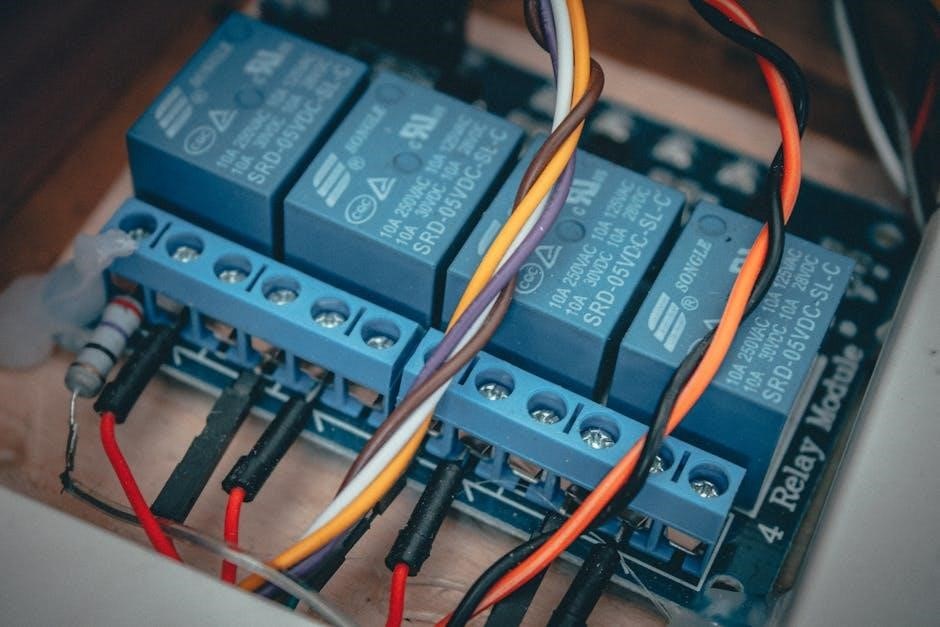
Visually‚ a 4-way switch typically features four terminals (excluding the ground). These terminals are arranged in pairs‚ and the switch internally connects one pair to the other‚ effectively changing the circuit’s route. This internal switching action is what allows for multi-location control.

Understanding that no standard wiring diagram exists is crucial. Configurations depend heavily on the existing 3-way switch setup and the location of the power source and light. Discussions on platforms like Reddit highlight that simply matching wire colors to terminals is often the most reliable approach when replacing a 4-way switch‚ particularly in older homes with NM copper wiring.

Applications of 4-Way Switches

4-way switches excel in scenarios demanding lighting control from multiple points‚ most commonly found in hallways‚ stairwells‚ and large rooms with entrances at opposite ends. Imagine controlling a hallway light from the top and bottom of the stairs – this is a prime application.

Beyond residential settings‚ they’re useful in larger spaces like offices or workshops where convenient access to lighting controls is paramount. The ability to turn a light on at one entrance and off at another enhances both convenience and security.

However‚ implementing these systems requires careful consideration‚ as the wiring can be more intricate than standard setups. Online forums‚ such as Home Improvement Stack Exchange‚ emphasize the lack of a universal 4-way switch wiring diagram‚ meaning each installation may require a tailored approach. Successfully utilizing 4-way switches often involves replicating existing wiring configurations‚ especially in older homes utilizing NM copper wiring.

Essential Components & Wiring Basics

Understanding the terminals and wire colors is vital for 4-way switch wiring‚ often involving 12/3 or 14/3 NM copper wiring.
Careful identification is key to success.

Identifying 4-Way Switch Terminals

Four-way switches differ significantly from standard single-pole or three-way switches in their terminal arrangement. Unlike the common/traveler setup of 3-way switches‚ 4-way switches feature four traveler terminals and a common terminal. These traveler terminals are typically arranged in pairs on opposite sides of the switch body.

Identifying these terminals is crucial before beginning any wiring work. The common terminal is often a different color than the traveler terminals – frequently dark or black. The traveler terminals are usually brass-colored. It’s important to note that screw color isn’t a reliable indicator‚ as manufacturers can vary.

Carefully observe the existing wiring before disconnecting anything. Note which wires are connected to which terminals. Taking pictures can be incredibly helpful. The goal is to replicate the existing connections accurately when installing the new switch. Remember‚ the absence of a standard diagram necessitates meticulous attention to detail when tracing the existing wiring configuration.

Common Wire Colors Used in 4-Way Switch Circuits

Understanding wire colors is fundamental to safely and correctly wiring a 4-way switch circuit. Typically‚ NM copper wiring (often 12/3 or 14/3) is used in these setups. This cable contains a black (hot)‚ white (neutral)‚ and red (traveler) wire‚ plus a bare copper or green ground wire.


The black wire usually carries the power source (line) to the first switch. The white wire is generally used as a neutral‚ though it can sometimes be re-identified as a hot wire in specific configurations. Red and another color wire (often black or blue) serve as the traveler wires‚ connecting the two 3-way switches to the 4-way switches.

However‚ it’s vital to remember that wire color conventions aren’t always strictly followed‚ especially in older installations. Always verify the function of each wire with a voltage tester before making any connections. Accurate identification prevents dangerous miswiring and ensures the circuit functions as intended.

The Role of Traveler Wires

Traveler wires are the cornerstone of 4-way switch functionality‚ enabling control of a light fixture from multiple locations. These wires‚ typically red and another color (often black)‚ connect the two 3-way switches through the 4-way switch(es).

Their purpose is to “carry” the electrical current’s path between the 3-way switches‚ allowing either switch to interrupt or complete the circuit‚ regardless of the other’s position. The 4-way switch doesn’t break or complete the circuit itself; it merely redirects the traveler wires.

Effectively‚ the 4-way switch swaps the connections of the traveler wires‚ changing which 3-way switch is “active” in the circuit. Correctly identifying and connecting these traveler wires is paramount for proper operation. Miswiring them will result in unpredictable behavior or a non-functional circuit‚ highlighting the importance of careful attention during installation.

Step-by-Step Wiring Guide

Due to the lack of a standardized 4-way switch diagram‚ meticulous documentation of the existing wiring is essential before disassembly. Careful replication is key!

Wiring Diagram Overview (No Standard Diagram)

Unlike simpler circuits‚ a universally accepted‚ standardized wiring diagram for 4-way switches simply doesn’t exist. This is a critical point often emphasized in online discussions‚ such as those found on Home Improvement Stack Exchange. The wiring configurations can vary significantly depending on how the initial installation was performed.

Consequently‚ relying on generic diagrams can be misleading and potentially lead to incorrect wiring. Instead‚ the most reliable approach involves thoroughly documenting the existing wiring before disconnecting anything. This documentation should include noting the wire colors connected to each terminal on all switches involved – the two 3-way switches and the two 4-way switches.

Photographs are invaluable in this process. The goal is to be able to recreate the original connections precisely. Remember that 12/3 or 14/3 NM-B copper wiring is commonly found in these setups‚ indicating the presence of traveler wires. Without a clear understanding of the original layout‚ troubleshooting becomes significantly more difficult.

Connecting the Power Source (Line)

The “line” wire‚ carrying power from the electrical panel‚ is typically connected to one of the 3-way switches‚ not directly to a 4-way switch. Identifying the line wire is crucial for safety and proper functionality. It’s usually a black wire‚ but always verify with a non-contact voltage tester before making any connections.

This line wire connects to the “common” terminal on the first 3-way switch. The common terminal is often a different color than the other two terminals – typically black or dark-colored. Ensure the power is OFF at the breaker before working with any wiring.

Carefully note how the line wire is connected; this is vital for recreating the circuit correctly. In scenarios where the line and load are in the same box (as discussed in SmartThings Community forums regarding GE Z-Wave switches)‚ the wiring becomes more complex and requires extra caution and detailed documentation.

Connecting the Light Fixture (Load)

The “load” wire‚ which powers the light fixture itself‚ connects to the “common” terminal of the second 3-way switch. Similar to the line wire‚ the load is often a black wire‚ but confirmation with a voltage tester is essential. This connection completes the circuit‚ allowing the switches to control the flow of electricity to the light.

Before connecting‚ ensure the power is completely shut off at the breaker. Carefully observe the existing wiring configuration‚ as variations can occur‚ especially in older homes with NM copper wiring. Documenting the connections before disconnecting anything is highly recommended‚ particularly given the lack of a standardized 4-way switch diagram.

Properly securing the load wire to the common terminal is vital for a safe and reliable connection. Incorrect wiring can lead to flickering lights or‚ worse‚ a fire hazard.

Wiring the First 3-Way Switch

Begin by connecting the power source – the “line” wire – to one of the traveler terminals on the first 3-way switch. Typically‚ this is a black wire‚ but always verify with a voltage tester before making any connections. The remaining traveler terminal receives the other traveler wire‚ which will run to the second 3-way switch.

The common terminal on this first switch will not connect directly to the light fixture. Instead‚ it’s crucial to remember this switch acts as an intermediary‚ directing power along the traveler wires. Given the absence of a standard 4-way diagram‚ meticulous attention to matching existing wire colors and terminal positions is paramount.

Securely fasten all connections‚ ensuring no bare wire is exposed; A loose connection can cause intermittent operation or a potential safety hazard.

Wiring the Second 3-Way Switch

Similar to the first 3-way switch‚ connect the traveler wires arriving from the first switch to the traveler terminals on this second switch. Maintaining consistent color-coding is vital for proper functionality. The common terminal on this second 3-way switch is where you’ll connect the wire leading to the first 4-way switch.

Remember‚ the goal is to create a continuous path for electricity to flow‚ controlled by the combined action of all four switches. As emphasized by online resources‚ replicating the existing wiring configuration is key‚ especially given the lack of a standardized 4-way switch diagram.

Double-check all connections for tightness and ensure no bare wires are exposed. Proper insulation is crucial for safety and reliable operation.

Connecting the Two 4-Way Switches

The two 4-way switches are interconnected using traveler wires. These aren’t simply connected to the common terminals; instead‚ they utilize all four terminals on each switch. Connect the traveler wires from the first 4-way switch to the corresponding traveler terminals on the second 4-way switch – matching is crucial.

Online discussions‚ like those on Home Improvement Stack Exchange‚ stress the importance of understanding that 4-way wiring deviates from standard diagrams. Carefully observe the existing wiring‚ noting the color scheme and terminal connections. Replicate this precisely on the new switches.

Ensure secure connections and proper insulation. Incorrect wiring can lead to malfunctions or safety hazards. Remember‚ the traveler wires facilitate the switching action between the two 3-way switches.

Troubleshooting Common Issues

Identifying incorrect wiring is key‚ as 4-way circuits lack a standard diagram. Issues with GE Z-Wave switches‚ or line/load in the same box‚ require careful diagnosis.

Identifying Incorrect Wiring

Diagnosing wiring errors in a 4-way switch circuit demands a systematic approach‚ given the absence of a universally accepted standard diagram. Begin by meticulously comparing the existing wiring configuration to any notes or photographs taken before disassembly. A common mistake involves misidentifying traveler wires; these are crucial for proper functionality and should be connected consistently across all switches.

If the lights don’t operate as expected – perhaps only working from one switch location‚ or failing to turn off completely – carefully re-examine the connections. Ensure that the power source (line) and the light fixture (load) are correctly identified and wired to the appropriate terminals on the 3-way switches. Online forums‚ like those on Reddit (r/electrical)‚ often discuss similar issues‚ providing valuable insights from experienced users.

Remember that incorrect wiring can not only cause inconvenience but also pose a safety hazard. If you are uncomfortable or unsure about any aspect of the wiring process‚ it is always best to consult a qualified electrician.

Dealing with Line and Load in the Same Box

Situations where both the power source (line) and the light fixture (load) reside within the same electrical box present a unique challenge in 4-way switch wiring. This configuration‚ while not ideal‚ is sometimes encountered in older homes or during renovations. Successfully navigating this requires careful attention to detail and a clear understanding of how traveler wires function.

The SmartThings Community forums highlight the complexities of wiring GE Z-Wave switches in such scenarios‚ emphasizing the need for a specific wiring approach. Typically‚ the line and load are connected to one of the 3-way switches‚ while the remaining two switches (the 4-ways) handle the traveler wires.

Accurate identification of these wires is paramount. Incorrect connections can lead to unpredictable behavior or even a short circuit. Always double-check your work against any existing diagrams or notes‚ and if uncertainty persists‚ consult a qualified electrician to ensure a safe and functional installation.

Addressing Issues with GE Z-Wave Switches

Integrating GE Z-Wave switches into a 4-way circuit introduces specific considerations due to their smart functionality and wiring requirements. The SmartThings Community frequently discusses challenges encountered when using a GE master switch paired with two auxiliary switches in a 4-way setup‚ particularly when the line and load are within the same box.

Common issues often stem from incorrect traveler wire connections or improper configuration within the Z-Wave network. Ensuring the master switch is correctly identified and paired is crucial. Auxiliary switches rely on the master for communication and control‚ so any disruption in this link can cause malfunctions.

Carefully review the GE Z-Wave switch documentation and wiring diagrams. If problems persist‚ resetting the switches and re-pairing them to the hub can often resolve connectivity issues. Remember to consult online forums and support resources for specific troubleshooting steps related to GE Z-Wave devices.

Advanced Considerations

Complex setups‚ like 16-way dial switches or Godown wiring diagrams with three switches‚ demand a thorough understanding of traveler wires and terminal functions (XT1)‚ especially with NM copper wiring.

Wiring with NM Copper Wiring (12/3 or 14/3)

When encountering NM copper wiring – specifically 12/3 or 14/3 – in a 4-way switch circuit‚ it indicates a more modern wiring approach. This cable contains four current-carrying conductors plus a ground‚ facilitating the necessary connections for the traveler wires crucial to 4-way functionality.

The Reddit discussion highlights that homes with this wiring often utilize a 4-way switch setup‚ meaning replacing an existing switch simply requires obtaining another 4-way switch and meticulously matching the wire connections based on screw color. This simplifies the process‚ as the existing wiring is already configured correctly for a 4-way system.

However‚ careful attention must be paid to identifying the traveler wires and ensuring they are connected to the corresponding terminals on the new switch. Incorrect wiring can lead to malfunctioning lights or‚ in worst-case scenarios‚ electrical hazards. Always double-check connections against the original configuration before restoring power.

Godown Wiring Diagrams (3 Switch Configurations)

The referenced documentation summarizes a “godown wiring diagram” featuring three switch configurations‚ likely representing variations within a larger electrical system. While specifics are limited without the full diagram‚ this suggests a complex setup potentially incorporating multiple 4-way switches or combinations of 3-way and 4-way switches to control lighting from various locations.

Understanding these configurations requires careful analysis of the wiring layout‚ identifying the power source (line)‚ the light fixture (load)‚ and the traveler wires connecting the switches. The diagram likely illustrates how these components interact to achieve the desired switching functionality.

It’s important to note that these “godown” diagrams may not adhere to standard wiring practices‚ necessitating a thorough understanding of electrical principles and a cautious approach to troubleshooting or modifications. Accurate documentation and careful tracing of wires are essential when working with non-standard wiring schemes.

16-Way Dail Switch Function & 4-Way Terminal (XT1)

The documentation briefly mentions a “16-WAY DAIL SWITCH FUNCTION” alongside a “4-WAY TERMINAL (XT1)”. This suggests a highly complex switching system‚ far beyond typical residential setups. The “XT1” terminal likely refers to a specific connection point on the switch‚ potentially used for controlling a large number of lights or circuits.

The reference to “S1 DAIL SWITCH” and associated addresses (A BO. N. WHITE. BLUE. Y/G) indicates a coded system for identifying switch positions or functions within the 16-way configuration. Understanding this coding is crucial for interpreting the switch’s operation.

Furthermore‚ the mention of “SHORT W1 AND W2. LOW VOLTAGE SIGNAL” suggests the system may utilize low-voltage control signals to manage the extensive switching network. This type of setup is likely found in industrial or commercial applications requiring precise control over numerous lighting zones.

summer and smoke play pdf

Summer and Smoke, a poignant play by Tennessee Williams, is readily available as a PDF for study and performance, offering a deep dive into its themes.

Overview of the Play

Summer and Smoke, penned by Tennessee Williams in 1950, delves into the complex interplay between spiritual aspirations and earthly desires within a changing American South. Finding a Summer and Smoke play PDF allows exploration of this nuanced drama. The script showcases Alma Winemiller’s internal conflict and her fraught relationship with John Buchanan Jr.

Numerous online resources offer downloadable scripts, facilitating study and potential stage productions. The play’s exploration of repression and identity resonates deeply, making the PDF version a valuable resource for students and theatre enthusiasts alike. It’s a subtle and tender work.

Tennessee Williams and His Works

Tennessee Williams, a titan of 20th-century American theatre, is celebrated for his emotionally charged dramas exploring the human condition. Accessing a Summer and Smoke play PDF provides insight into his distinctive style. Known for works like “A Streetcar Named Desire” and “Cat on a Hot Tin Roof,” Williams often examined themes of desire, loneliness, and societal constraints.

His plays frequently feature complex characters grappling with internal conflicts. Studying the PDF script reveals Williams’ masterful use of dialogue and symbolism, hallmarks of his enduring legacy in dramatic literature.

Plot Summary of “Summer and Smoke”

Summer and Smoke’s narrative, easily followed via a play PDF, centers on Alma and John, navigating societal expectations and repressed desires in a changing South.

Act I: Establishing the Characters and Setting

Act I, accessible within a Summer and Smoke play PDF, meticulously introduces the inhabitants of Glorious Hill, Mississippi, in 1916. We meet Alma Winemiller, a repressed and intellectual young woman, and John Buchanan Jr., a handsome medical student. The setting—a small town grappling with evolving morals—is crucial.

Williams skillfully establishes the contrasting worlds of the spiritual and the sensual, foreshadowing the central conflict. The PDF reveals initial interactions hinting at a burgeoning, yet complicated, attraction between Alma and John, setting the stage for their emotional journey.

Act II: The Developing Conflict

Act II, easily followed within a Summer and Smoke play PDF, witnesses the escalating tension between Alma and John. John, having spent time away, returns transformed – embracing a more worldly and physical existence. This shift deeply unsettles Alma, whose rigid moral code clashes with his newfound freedom.

The PDF showcases their increasingly fraught encounters, revealing Alma’s desperate attempts to reconcile her attraction to John with her deeply ingrained beliefs. The conflict intensifies, fueled by misunderstandings and unspoken desires, driving the narrative forward.

Act III: Climax and Resolution

Act III, clearly presented in any complete Summer and Smoke play PDF, delivers the play’s heartbreaking climax. Alma, confronting her repressed desires, makes a desperate and ultimately unsuccessful attempt to connect with John on a physical level. This pivotal scene exposes the full extent of their emotional disconnect.

The PDF reveals a somber resolution, with both characters left grappling with the consequences of their choices and the impossibility of bridging the gap between their worlds, leaving a lasting sense of tragedy.

Key Characters in “Summer and Smoke”

Summer and Smoke play PDF versions detail Alma, John, and Rosa—central figures whose complex interactions drive the narrative and explore the play’s core themes.

Alma Winemiller: The Central Protagonist

Alma Winemiller, as depicted within the Summer and Smoke play PDF, embodies a fascinating internal conflict. She’s a deeply spiritual, yet repressed young woman navigating societal expectations and her own burgeoning desires. The script reveals her struggle between upholding a virtuous image and acknowledging her physical attraction to John Buchanan Jr.

Her character arc, meticulously detailed in available PDFs, showcases a journey of self-discovery, marked by loneliness and a yearning for genuine connection. Alma’s complexities are central to understanding Williams’ exploration of repression and the search for fulfillment.

John Buchanan Jr.: The Object of Alma’s Affection

Examining the Summer and Smoke play PDF reveals John Buchanan Jr. as a catalyst for Alma’s internal turmoil. Initially presented as a respectable young man, the script details his descent into a more hedonistic lifestyle, contrasting sharply with Alma’s ideals.

His character, fully fleshed out in the downloadable script, embodies the “smoke” – illusion and escape – that draws him away from the perceived constraints of Glorious Hill. John’s journey highlights the play’s central conflict between spiritual and physical desire, profoundly impacting Alma.

Rosa Gonzales: A Foil to Alma

A close reading of the Summer and Smoke play PDF demonstrates Rosa Gonzales’ crucial role as a foil to Alma Winemiller. Rosa embodies a free-spirited, sensual nature, openly embracing her physicality – a direct contrast to Alma’s repressed desires.

The script reveals Rosa’s acceptance of life’s pleasures, highlighting Alma’s internal struggle. Through Rosa, Williams explores alternative paths and societal expectations, enriching the play’s thematic depth and providing a stark comparison to Alma’s character.

Themes Explored in “Summer and Smoke”

Analyzing the Summer and Smoke play PDF reveals central themes of spiritual versus physical desire, repression, and the complex search for identity and fulfillment.

The Conflict Between Spiritual and Physical Desire

Summer and Smoke’s core tension, vividly apparent within the play PDF, centers on the opposing forces of spiritual aspiration and raw, physical longing. Alma Winemiller embodies repressed spirituality, while John Buchanan Jr. initially represents hedonistic impulses.

Williams masterfully portrays this conflict, showcasing how societal expectations and personal inhibitions can stifle natural desires. The downloadable script allows close examination of dialogue and stage directions, revealing the characters’ internal struggles. This dichotomy fuels the play’s dramatic arc, ultimately questioning the possibility of reconciling these fundamental human needs.

Repression and Its Consequences

The play PDF of Summer and Smoke powerfully illustrates the damaging effects of repression, particularly concerning sexuality and emotional expression. Alma Winemiller’s rigid upbringing and internalized societal norms lead to profound psychological distress.

Williams demonstrates how suppressing natural desires can manifest as neurosis and distorted relationships. Studying the script reveals Alma’s desperate attempts to find fulfillment within restrictive boundaries, ultimately highlighting the destructive consequences of denying one’s true self. The text underscores the importance of authentic emotional release.

The Search for Identity and Fulfillment

Analyzing the Summer and Smoke play PDF reveals a central theme: the characters’ yearning for self-discovery and genuine connection. Both Alma and John Buchanan Jr. grapple with defining who they are beyond societal expectations and personal inhibitions.

The script details their individual journeys, fraught with internal conflict and missed opportunities. Williams portrays the complexities of finding fulfillment, suggesting it requires confronting one’s vulnerabilities and embracing authentic desires. The downloadable script offers insight into their struggles.

Symbolism in “Summer and Smoke”

Summer and Smoke play PDF analysis highlights potent symbolism; smoke embodies illusion, while the setting of Glorious Hill reflects societal and personal facades.

Smoke as a Symbol of Illusion and Escape

Within the “Summer and Smoke” play PDF, smoke consistently represents the characters’ attempts to evade reality and construct illusory worlds. It embodies fleeting desires and the deceptive nature of appearances, particularly for Alma Winemiller.

The pervasive presence of smoke—from cigarettes to the metaphorical “summer smoke”—obscures genuine connection and fuels self-deception. It signifies a yearning for escape from societal constraints and personal anxieties, ultimately hindering true fulfillment. Analyzing the PDF reveals how Williams masterfully employs this symbol.

The Setting of Glorious Hill as Symbolic Representation

Examining the “Summer and Smoke” play PDF reveals Glorious Hill isn’t merely a location, but a potent symbol of a fading Southern gentility and repressed desires. The hill’s elevated position suggests a striving for spiritual and social superiority, yet its isolation hints at stagnation.

Within the PDF’s stage directions, Glorious Hill embodies the characters’ internal conflicts – a yearning for connection versus a fear of vulnerability. It’s a microcosm of the play’s central themes, beautifully illustrated through Williams’ descriptive language.

Historical Context of the Play

Summer and Smoke’s play PDF reflects 1950s America, grappling with changing social norms and the rising influence of Freudian psychoanalysis on dramatic works.

American Society in the 1950s

Summer and Smoke’s play PDF emerges from a post-war America experiencing significant societal shifts. The 1950s were marked by conformity, conservative values, and a burgeoning consumer culture, yet beneath the surface lay anxieties about sexuality and repression. This era witnessed a strong emphasis on traditional gender roles and family structures, creating internal conflicts for individuals like Alma Winemiller.

The availability of the PDF allows modern audiences to examine how Williams’ work critiques these societal pressures, reflecting a period of both prosperity and underlying tension.

The Influence of Psychoanalysis on Williams’ Work

Accessing a Summer and Smoke play PDF reveals Williams’ profound engagement with psychoanalytic theory, particularly Freudian concepts. His characters grapple with repressed desires, internal conflicts, and the impact of childhood experiences – all central to psychoanalytic thought. The play explores the subconscious motivations driving behavior, mirroring Freudian ideas about the id, ego, and superego.

Studying the PDF illuminates how Williams used these principles to portray complex psychological states, making his work deeply insightful and emotionally resonant.

“Summer and Smoke” as a Reflection of Williams’ Life

A Summer and Smoke play PDF showcases autobiographical elements, mirroring Williams’ own struggles with desire, repression, and societal expectations, deeply influencing the narrative.

Autobiographical Elements in the Play

Summer and Smoke, accessible through a readily available play PDF, resonates with Williams’ personal experiences. The play’s exploration of repressed sexuality and spiritual longing mirrors his own internal conflicts. Alma Winemiller’s character, particularly, reflects Williams’ complex relationship with his mother and societal pressures surrounding female sexuality.

The setting, reminiscent of his childhood in Mississippi, and the characters’ struggles with identity, further demonstrate the autobiographical nature of the work. Studying the PDF reveals how Williams transformed personal pain into a universally relatable narrative, examining the delicate balance between societal expectations and individual desires.

Adaptations of “Summer and Smoke”

Summer and Smoke inspired Lee Hoiby’s opera, and numerous stage revivals; the original play PDF remains crucial for understanding these artistic interpretations.

The Opera by Lee Hoiby

Lee Hoiby transformed Tennessee Williams’ Summer and Smoke into a compelling opera, premiered in 1971 with a libretto by Lanford Wilson. Accessing the original play PDF is invaluable for appreciating Hoiby’s musical interpretation of the characters and narrative. The opera expands upon the play’s exploration of spiritual versus physical desire, offering a different artistic lens. Studying both the script PDF and the operatic score reveals the nuances of Williams’ work and Hoiby’s adaptation, showcasing how themes resonate across mediums. It’s a powerful example of interdisciplinary art.

Stage Productions and Revivals

Summer and Smoke has seen numerous stage productions and revivals since its debut, demonstrating its enduring appeal. Having a play PDF readily available aids directors and actors in preparing for these performances. Analyzing the script PDF reveals Williams’ detailed stage directions, crucial for capturing the play’s atmosphere. Revivals often offer fresh interpretations of Alma and John’s complex relationship. Access to the PDF allows for detailed textual analysis, informing nuanced character portrayals and impactful staging choices, ensuring the play’s continued relevance.

Critical Reception and Analysis

Summer and Smoke initially received mixed reviews, but modern analysis, aided by accessible play PDF versions, highlights its thematic depth and psychological complexity.

Initial Reviews of the Play

Upon its 1951 debut, Summer and Smoke garnered varied critical responses. Some reviewers praised Tennessee Williams’ delicate exploration of repression and desire, noting the play’s lyrical language and nuanced characters. However, others found the narrative slow-paced and overly symbolic, struggling with its unconventional structure.

The availability of the play PDF today allows for a re-evaluation of these initial reactions, enabling modern audiences and scholars to engage directly with Williams’ text and form their own informed opinions regarding its artistic merits and enduring relevance.

Modern Interpretations of “Summer and Smoke”

Contemporary analyses of Summer and Smoke often focus on its feminist undertones and exploration of societal constraints placed upon women in the 1950s. The readily accessible play PDF facilitates detailed textual study, revealing Alma Winemiller’s struggle against patriarchal expectations.

Scholars also examine the play through a psychoanalytic lens, influenced by the era’s growing interest in Freudian concepts, further enriching understanding of its complex characters and motivations.

Finding a “Summer and Smoke” Play PDF

Summer and Smoke’s script in PDF format can be found through Dramatists Play Service and other online sources, offering convenient access.

Reliable Sources for Play Scripts

Dramatists Play Service is a premier source for obtaining Summer and Smoke as a PDF or physical copy, ensuring an authorized and accurate script. Several university libraries also offer digital access to play scripts, including Williams’ works, for research purposes.

Online booksellers frequently list the play, sometimes providing PDF versions, but verifying authenticity is crucial. Websites dedicated to theatrical resources can also be helpful, though copyright considerations should always be respected when downloading or sharing scripts.

Legal Considerations When Downloading PDFs

Downloading Summer and Smoke as a PDF requires respecting copyright laws. Unauthorized reproduction or distribution of copyrighted play scripts is illegal and infringes on the playwright’s rights.

Obtain scripts only from authorized sources like Dramatists Play Service to ensure legal compliance. Educational use may fall under fair use guidelines, but performance rights require separate licensing. Always verify the source’s legitimacy before downloading to avoid potential legal issues and support the arts.

The Significance of the Play’s Title

Summer and Smoke’s title embodies the conflict between youthful idealism (“summer”) and the illusions that obscure reality (“smoke”), explored within the PDF script.

Exploring the Metaphorical Meaning

Summer represents a time of youthful passion, vibrancy, and potential—a period of blossoming desires and innocent longing, readily accessible when studying the play’s PDF version. Conversely, smoke symbolizes illusion, evasion, and the obscuring of truth, mirroring the characters’ attempts to escape their inner turmoil.

This duality, central to Williams’ work, is powerfully conveyed through the play’s narrative. The title suggests a fleeting, ephemeral quality to joy and fulfillment, hinting at the inevitable dissipation of dreams. Examining the PDF allows a deeper understanding of how these metaphors intertwine, shaping the characters’ fates and the play’s overall message.

The Role of Setting in Conveying Themes

Glorious Hill’s depiction within the PDF script powerfully reinforces themes of repression and societal constraints, shaping character interactions and desires.

Glorious Hill and its Impact

Glorious Hill, meticulously detailed within the readily accessible Summer and Smoke PDF script, transcends a mere location; it embodies the stifling societal norms of the American South. The boarding house and its surroundings symbolize a fading, genteel past, contrasting sharply with the burgeoning modernity and sensual awakening experienced by the characters.

This setting actively contributes to Alma’s internal conflict, representing both her spiritual aspirations and the repressed desires that haunt her. Examining the stage directions within the PDF reveals how Williams utilizes the physical space to mirror the characters’ emotional states, intensifying the play’s thematic resonance.

The Play’s Exploration of Gender Roles

Summer and Smoke’s PDF reveals societal expectations confining Alma and John, highlighting their struggles against prescribed roles and desires within a changing era.

Alma and John’s Relationship in a Societal Context

Summer and Smoke’s PDF script vividly portrays Alma and John’s complex connection, deeply influenced by 1950s societal norms. Alma, representing spiritual idealism, clashes with John’s burgeoning physicality, a conflict exacerbated by societal pressures.

The play, accessible through its PDF format, demonstrates how restrictive gender roles and expectations hinder their ability to connect authentically. John’s eventual descent reflects the era’s temptations, while Alma’s repression showcases the consequences of societal constraints. Their dynamic, fully revealed in the PDF, is a powerful critique of the period’s limitations.

The Use of Dialogue and Stage Directions

Summer and Smoke’s PDF reveals Williams’ distinctive style, employing poetic dialogue and detailed stage directions to convey character psychology and atmosphere.

Williams’ Distinctive Style

Summer and Smoke’s PDF showcases Tennessee Williams’ masterful command of dramatic technique. His writing blends lyrical prose with realistic dialogue, creating a uniquely evocative atmosphere. The PDF allows close examination of his symbolic use of language and imagery, particularly regarding the central metaphor of smoke itself.

Stage directions within the PDF are incredibly detailed, revealing Williams’ precise vision for character movement, setting, and emotional nuance. This meticulous approach, evident in the script’s PDF format, contributes significantly to the play’s overall impact and enduring appeal.